Showing posts with label TSA. Show all posts

Tuesday, July 11, 2017

The Best Baby Travel Gear: Food and Drink Edition


Best baby travel gear for food and drink
You're taking your baby on an international trip, and you've got all the baby travel gear you'll need for transportation. But what about the items you'll need to feed your baby once you get to your destination? You might be looking around your kitchen in despair, wondering how you're going to transport all the myriad items you use for your baby. Don't stress out! We've consulted with expert traveling parents to find out exactly which baby feeding items are travel must-haves, and what you can leave at home. Today we'll cover the things you'll need to feed your baby while you travel.


A hungry baby is an unhappy baby, and you do not want an unhappy baby as a travel companion.


Bottle-Feeding While You Travel


For babies too young to eat solid food, your travel feeding gear will be pretty simple. Babies who are exclusively breastfed don't need any special equipment at all - they just need mom! If your baby takes bottles, bring along several of the bottles your baby prefers. Fill a travel-size bottle with dish soap and bring a small bottle brush so you can clean the bottles in your hotel room. We also recommend bringing some pacifier and bottle wipes so you can do a quick clean up of bottles while you are out and about.

Don't Bring: multiple cans of formula, unless your baby takes a very special variety. The major formula brands you're familiar with are sold in countries around the world. Similac, for example, is available in 96 countries! Save the space in your suitcase, and purchase more formula from a local grocery or drug store. You'll need to go to the store to buy bottled water, anyway!


Sippy Cups Are a Travel Must-Have


Sippy cups are a travel must-have
For older babies and toddlers, you'll want to bring a leak-proof sippy cup so you can carry water for your baby without making a mess. You probably already have a collection of sippy cups at home. For travel, choose one that is as leak-proof as possible. You'll also want to pick one that is easy to clean, without complicated valves and straws. Our favorite is the Munchkin Miracle 360 Sippy Cup

We also think that silicone sippy cup lids are perfect for travel. You can pop these stretchy lids on to just about any glass or sturdy cup. It makes it so easy to get your baby a drink at a restaurant, without having to memorize the phrase "I'm sorry for the mess" in the local language! The silicone lids are also very easy to clean because they are just one piece. No worries about curdled milk or sticky juice lingering in the sippy cup!


Baby Travel Gear for Restaurant Meals


One of the best parts of traveling is getting to eat at lots of restaurants. But as a parent of a baby or toddler, you know it's a bit more complicated when you have a tiny diner with you!

The biggest issue you're likely to face when you eat out with your baby in a foreign country is the highchair, or lack thereof! In the US, we're used to restaurants supplying highchairs and booster seats for our kids. This is not always the case when you travel overseas. Even in well-developed countries like Italy, you'll find that many restaurants do not have highchairs for babies. When you do find a highchair, you might discover that it lacks straps or is otherwise unsafe. (We heard one story of a traveler who put his one-year-old in a restaurant highchair, only to have the back fall off of it, exposing sharp and rusty nails!)

While you certainly can hold your child in your lap while you eat, it's a lot more relaxing to have your baby secured in her own chair. If you have room for it, a portable feeding chair that straps on to a dining chair is an awesome piece of baby travel gear. The Summer Infant Pop N' Sit Portable Booster is the most popular option on Amazon. It folds up into a small package, and also has a convenient feeding tray. Another, even smaller, option is a cloth harness to strap your baby into his own chair.

Is baby a messy eater? (Are any babies NOT messy eaters?) Consider picking up a napkin clip or two so you can turn any napkin, cloth, or paper towel into a quick travel bib.

Don't Bring: baby's own bowls, plates, or cutlery. Your baby can eat using a regular teaspoon, off of a saucer or bowl provided by the restaurant.


Snacks - The Secret to Baby Travel Bliss


Snacks - The secret to baby travel bliss
You wouldn't take your baby to the mall without an ample supply of snacks to keep her pacified. That same theory applies when you travel with your baby!

Make sure you have plenty of snacks with you when you board your flight with your baby. The best snacks for the airplane are small ones like puffs or Cheerios that you can slowly dole out, one by one, to keep your little one occupied.

You should be able to replenish your supply of snacks at local groceries at your destination. However, you should definitely bring a good snack container or two. The best baby snack containers for travel are ones that allow your baby to access just a piece or two at a time, without being too easy to dump out.


TSA Rules for Flying With Baby Food and Milk


You're likely familiar with the TSA's rule that you can't carry any liquids or gels larger than 3.4 ounces onto an airplane. But did you know the rules are different for baby food, formula, and pumped breastmilk?

The food and drink your baby will need for the flight are exempt from the TSA's limitations on liquids and gels. You are allowed to bring pureed baby food in a "reasonable quantity." This means you can bring enough food to get your child to your destination, so don't bring much more than you think you will need for your flight. Even if you prefer to make your own baby food, it's a good idea to bring commercially packaged jars or pouches of baby food.

You will need to pull your packages of baby food out of your carry-on bag to be screened separately. The packages may be swabbed with chemicals. Have some of those pacifier wipes on hand to clean them up before you feed them to your child.

You are also allowed to bring special drinks for your baby or toddler, such as premixed formula, milk, or juice. The TSA officer may ask you to open a container so they may test a small quantity.

Traveling with pumped breastmilk? You are allowed to bring ice packs or gel-filled freezer packs to keep the milk cold while you travel. If you are flying with a large quantity of breastmilk, you may want to consider freezing it solid and checking a cooler as luggage. Although there is no set limit on how much breastmilk you may bring in your carry-on bag, we have heard too many stories of mothers being forced to throw away their "liquid gold" by TSA officers who misunderstood the rules.   

 Tell us your baby travel stories in the comments!

Wednesday, March 15, 2017

Iris Scans: Could Your Eyes Become Your Passport?


Could an iris scan become your passport?
It might seem like something out of a James Bond movie, but iris scan technology is real, and may already be in use at your local airport! One company that manufactures eye-scanning technology envisions a future in which your eyes could be your passport. They could be your boarding pass and your credit card, too!
Imagine going to the airport and not having to pull out your wallet once. Instead of having your passport inspected at airport security, you’d be able to pass by an iris scan kiosk that would identify you within 2 seconds and verify that you are an approved traveler booked on an upcoming flight. You could breeze through security, leaving you plenty of time to visit the coffee bar in the terminal. There, you could look into another eye scanner – this one connected to credit card systems – to pay for your latte and scone.

Iris Scans and Biometrics

Iris scans are a form of biometrics – technology that identifies you based on your physical traits. Your passport already has biometric technology features. When you apply for a new passport, your passport photo is scanned and saved onto a tiny chip embedded in your passport. That scanned photo can be used for facial recognition purposes.

If you’ve ever read detective novels, you’re already familiar with one form of biometrics: fingerprints. Everyone has a unique set of fingerprints. Once your fingerprints are on file, they can be used to positively identify you.

The only problem with fingerprints and facial recognition for biometrics is that they can change over time. Just the forces of aging will change the contours of your face – sorry, but it’s true! Your face may change even more dramatically if you lose or gain weight, have an accident, or get plastic surgery. Your fingerprints also may change over the years. The pads of your fingers will wear and smooth as you age. Your fingerprints could also be damaged by scars or burns.

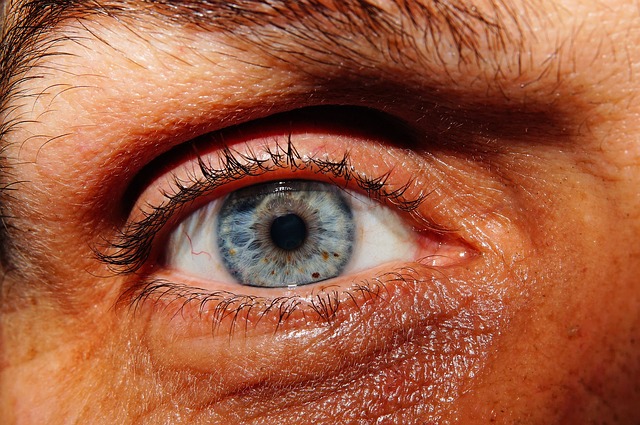
Your eyes, on the other hand, don’t change as you age. You might think of your eyes as just being blue or brown, but take a close look in the mirror. Your irises aren’t one solid color. You may see rings, rays, flecks, and freckles inside your iris. The pattern of your iris is just as unique as your fingerprints. No one else has eyes just like you. Even identical twins have their own distinctive iris pattern.

Your eyes are unique

How Does an Iris Scan Work?

If an iris scan sounds painful and intrusive, don’t worry. The basic part of an iris scanner is just a digital camera. To use an iris scanner, you simply look in to it, and the camera inside will capture images of your iris in both normal and near-infrared light. The infrared images help show the iris patterns in people with very dark eyes. The computer inside the iris scanner then analyzes the image and looks for a match in the database. Iris scanners created by Tascent, one of the companies building scanners for airports, can identify travelers with 99% accuracy in only two seconds.

In order for the iris scanner to recognize you, though, you’ve got to already be in the database. The process of having your iris scan added to the database is known as “enrollment.” Enrollment only takes a few minutes. You’d have your eyes scanned, and then your name and other details are entered in to the database along with the image of your irises.

Iris Scan Technology at the Airport

Although we might not yet be at the “airport of the future” stage with iris scanners everywhere, you may have already seen the technology at work. Iris scanners from Tascent are already in use for some screening purposes at airports in London and Dubai.

In the United States, iris scans are used in the CLEAR lanes now available at airport security at 22 major airports. People who are enrolled in CLEAR are able to use an automated kiosk to confirm their identity via iris scan or fingerprints. Once cleared by the kiosk, travelers can bypass the long line to have their ID checked by TSA security officers. They can go directly to the physical screening area, where their bags are screened as normal, and the traveler goes through the metal detector or millimeter-wave screening machine. CLEAR enrollment is separate from TSA Precheck or other Trusted Traveler programs, but works well as a complement to them.

Will Your Eyes Become Your Passport?

Your eyes contain identifying data
Don’t throw away your passport book quite yet! Although the technology exists, we’re a long way off from being able to phase out physical passport books. In order for iris scans to completely replace passports, every border crossing in the world would need to have the ability to scan traveler’s eyes. It’s one thing for airports in wealthy countries to install expensive machinery, but what about tiny dirt-runway airports in developing nations? Every airport, seaport, river crossing, or land border checkpoint on earth would need to have iris scanning technology available. Will your eyes become your passport? We’ll never say never… but we’ll say not yet, and not anytime soon.